Water damage is a sequence: water enters, spreads into building materials and, if it is not removed and dried, causes secondary damage such as swelling, odors and mold. What can be saved depends on the water category — clean, gray or black — the materials involved and how quickly drying starts.
Last reviewed · Reviewed against the sources listed on this page
Water damage is not one problem — it is a sequence. Water enters, spreads into materials, and if it is not removed and dried, it leads to secondary damage such as swelling, delamination, odor and mold. Understanding that sequence helps you make better decisions in the first hours.
01
Clean, gray and black water
The restoration industry commonly sorts water into three categories based on contamination. The category affects safety precautions, cleaning methods and which materials can be saved.
- Category 1 (clean water): from a sanitary source such as a supply line or faucet. Lowest risk when addressed quickly.
- Category 2 (gray water): contains some contamination — for example, washing machine or dishwasher discharge.
- Category 3 (black water): grossly contaminated — sewage, floodwater from outside, or water containing waste.
Water can get worse over time. Clean water that sits for days, or travels through dirty materials, may be treated as a higher category.
02
How water moves through a building
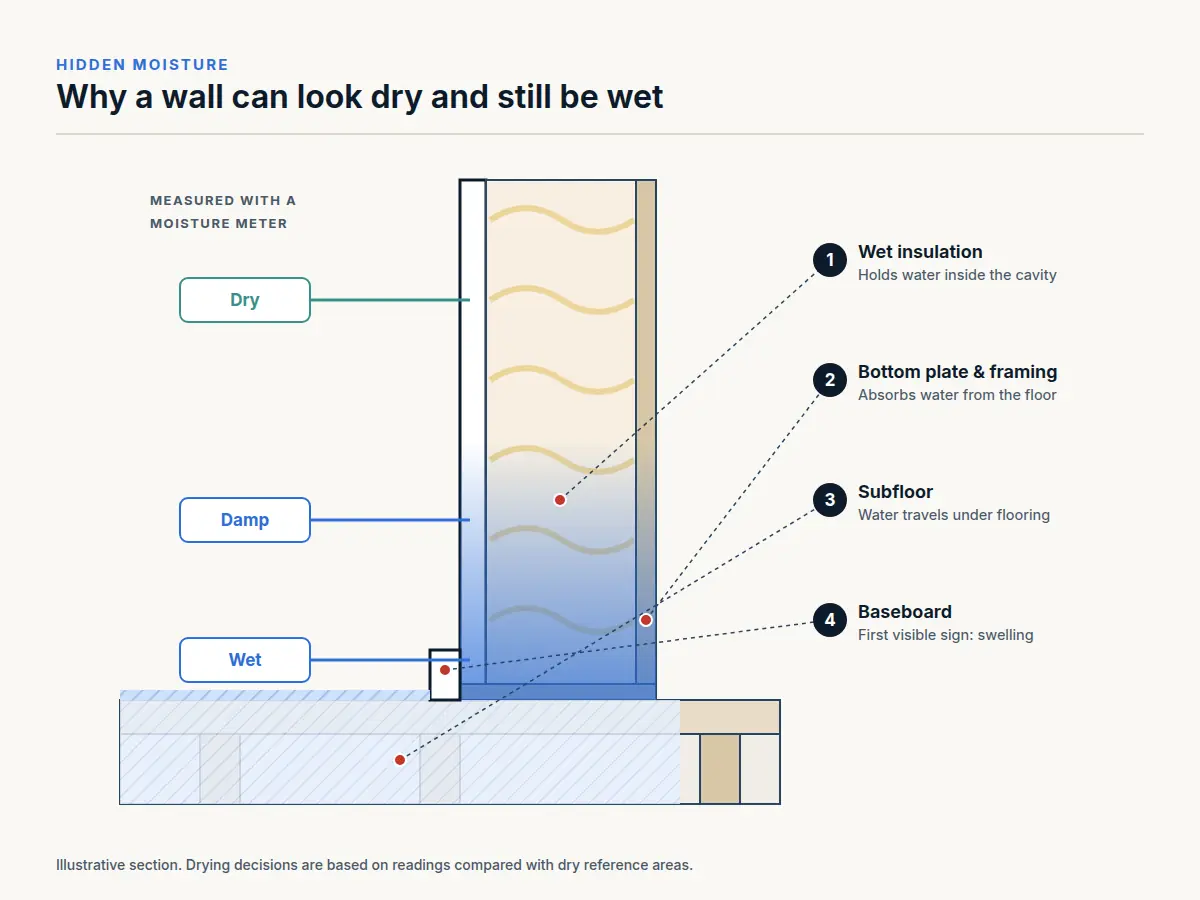
Water flows downhill, spreads under flooring, follows framing and pipes, and wicks upward into drywall and wood. That is why a leak upstairs often shows up as a ceiling stain in a different room, and why the visible wet spot is usually smaller than the actual wet area.
03
What can usually be saved
- Hard, non-porous surfaces: usually cleanable
- Drywall and framing affected by clean water: often dryable in place
- Carpet affected by clean water, caught early: often dryable; pad is frequently replaced
- Solid hardwood: sometimes dryable with specialized methods
- Particleboard, MDF and laminate: often swell and may need replacement
- Anything soaked by sewage or floodwater and porous: generally removed
04
Secondary damage
The longer materials stay wet, the more secondary damage occurs: swelling and cupping of floors, stained and crumbling drywall, rusting fasteners, odors and conditions where mold can grow. Fast, measured drying is the most effective way to limit it.
Sources & further reading
- A Brief Guide to Mold, Moisture and Your Home — U.S. EPA
- Flood Insurance — FEMA
Not sure how serious it is?
A professional assessment shows exactly where the water went and what it will take to dry and restore your property.